Loving a Baby Mommy Playing With a Baby
Playtime Is Over!
The modernistic demand to constantly pretend-play with our kids is exhausting. Is in that location a better way?
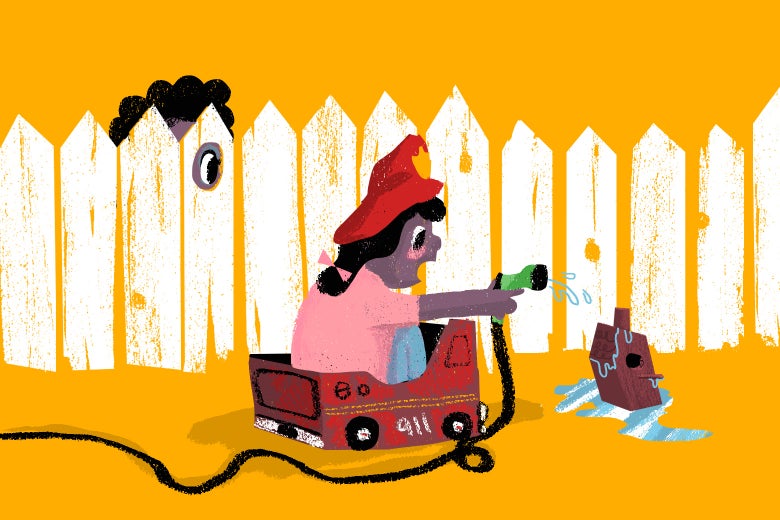
As a immature teenager, I babysat preschoolers. The feel earned me pocket change, taught me a bit about responsibility, and probably delayed my determination to become a mother for a decade or so. I hated being fabricated to play house, made to pretend to give birth to a doll (yup), and made to gallop around like a roaring lion. Play didn't feel fun to me, and the thought of living with someone who could typhoon me into this kind of activeness whenever they wanted was horrifying. Cut to the present, where my child is ii and about to go into the pretend-play phase: She'due south cradling dolls in her arms, putting them to "sleep" with pats and shushes, and I've been asked to "drink" more than one loving cup of "poffee" that's actually bathwater. It'due south adorable now, but I'thousand afraid of what's looming half-dozen months, or a year, down the route: "Play with me, Mommy!"
I'1000 not alone in harboring some reluctance toward pretend play—and block-building, and crafting, and coloring—nor in feeling like an expectation of play availability is a given of contemporary parenthood. I asked a Facebook group of mothers of young children, located across the country, how they felt well-nigh their children's bids to play with them. About of them reported feelings of failure and inadequacy. "I feel tremendous guilt that I don't want to play with my kids, at least non in the way they want me to," wrote a mom of a v- and iii-year-erstwhile. "I am currently 15 weeks pregnant with a sibling whose unabridged existence is pretty much predicated on the hope that he'll play with his older brother then that nosotros tin go back to having fourth dimension to ourselves," wrote another mom of a preschooler. "FINGERS CROSSED OUR PLAN WORKS." Meanwhile, editorials like Pamela Paul'southward recent New York Times stance piece beg us to pull dorsum, to allow our children to be "bored"—every bit if nosotros weren't trying.
How did and then many eye-class American parents get stuck with this guilt? Exercise our kids actually need us to play pretend with them all the time? And if they don't, how do we convince them of that fact? Because there's somebody in this house who wants to play "goggy" (correct now), and somebody else who'd rather … not.
Before the turn of the 20thursday century, about American children had work to do in the abode—and so did their parents. Just even as leisure time opened upwards for middle-class Americans, the expectation that a parent participate in play didn't immediately follow. In the 1920s, parenting experts actually told mothers (then the principal target of parenting advice) to stay away from their kids' amusements. Ann Hulbert, in her history of child-rearing advice, calls this school of thought the "anti-maternalist mode," which was predicated on a belief that "frostiness signaled efficiency."
John Watson's Psychological Care of Infant and Child, published in 1928, famously counseled mothers to stay away from their children's play altogether, because they'd ruin it. "The child is alone putting his blocks together, doing something with his hands, learning how to control his environment," Watson wrote. "The female parent comes in. Constructive play ceases. The child crawls its way or runs to the mother, takes hold of her, climbs into her lap, puts his arms around her neck … Blocks and the rest of the globe have lost their pulling ability." Watson's prescription for avoiding this kind of parental inference with play is i of the nigh stunning paragraphs in American kid-rearing communication and deserves to exist quoted in total:
If you haven't a nurse and can't leave the child, put it out in the backyard a big function of the day. Build a argue around the grand so that you are sure no harm can come to information technology. Do this from the fourth dimension it is born. When the child tin can crawl, give it a sandpile and exist certain to dig some small holes in the 1000 and then information technology has to crawl in and out of them. Let it acquire to overcome difficulties almost from the moment of birth. … If your center is too tender and you must watch the child, make yourself a peephole so that you tin can see it without being seen, or use a periscope.
If people were ever truly drilling debate peepholes to grab glimpses of their children cavorting (and Hulbert, besides as other historians of child-rearing communication, seriously doubt they were), that "frosty" manner was out of fashion by the postwar catamenia. In 1951, Martha Wolfenstein, a child psychologist, wrote an incisive commodity called "The Emergence of Fun Morality," which analyzed the contents of government-issued infant-intendance bulletins over the previous couple of decades.
Wolfenstein detected a ocean modify: "Fun, from beingness doubtable if non taboo, has tended to become obligatory."
Wolfenstein saw that the bulletins had altered the fashion they talked almost children's inherent impulses: "In the early catamenia there is a clear-cut distinction between what the babe 'needs,' his legitimate requirements, whatever is essential to his health and well-being, on the one manus, and what the baby 'wants,' his illegitimate pleasure strivings, on the other." The earlier bulletins' vision of a baby trying to "get" his mother to option him upward and entertain him was replaced, by the belatedly 1940s and early 1950s, with a picture of a child whose desires—including the desire for equally much parental interaction as could be provided—were fundamentally sound, and should be followed.
This alter in the perception of children's natures, Wolfenstein realized earlier than most, could mean more than pleasure for parents, or information technology could be a burden. "Play is now to exist fused with all the activities of life," she wrote. "Every bit the mother is urged to make play an aspect of every action, play assumes a new obligatory quality." The mother must not but conduct out every caretaking activity required of a good mom; she must likewise bounce and sing as she does it. Wolfenstein wrote, in a perfect summation of America'south all-or-nothing approach to parenting communication: "It seems difficult here for anything to become permissible without condign compulsory."
"Parents' obligation to go on children entertained increased steadily in the twentythursday century," historian Peter Stearns writes in his chronicle of the growth of American parental anxiety. Stearns hypothesized that new sources of heart-class parental guilt, stemming from the irresolute characteristics of American family life, provoked a new feeling that parents were responsible for children's good time. If a female parent (or begetter, under new expectations for paternal involvement in children'due south leisure in the postwar menstruum) was working almost of the week; if the parents were getting divorced; if kids now had to go to schools that were eating up their time and making them miserable; if parents didn't "requite" their child a sibling or ii; if parents couldn't provide a house in a neighborhood where information technology was safety to play outside—if any of these newly common conditions prevailed, middle-form parents felt more and more similar they "owed" their children skillful fun, under whatsoever terms the children required. Add new letters from advertisers about parental responsibilities for providing toys and educational materials, and new perceptions of threats to children's minds from "unwholesome" mass media like movies, radio, and comic books, and you have the recipe for late-20th-century (and early-21st-century) feet over eye-grade American kids' leisure.
It's worth noting here that the idea that a parent should be a caretaker, educator, and entertainer rolled into one is not but historically, but also culturally specific. "At that place are lots of cultures where [parent-child play is] considered admittedly inappropriate—a parent would never get downwards on their knees and play with the children. Playing is something children do, non something adults do," developmental psychologist Angeline Lillard said in an interview. "And that's but fine. At that place's no requirement for playing."
Differences in practices around parent-kid play be inside American subgroups, also. Sociologist Annette Lareau has observed a gap in beliefs nigh parent-child play between working-class/poor parents and heart-class parents in the United States. Working-grade and poor parents in her study held a view that they were responsible for "supervision in custodial matters" (Did the child get to slumber on time? Does the kid take sneakers that fit?) and "autonomy in leisure matters," while the middle-class parents engaging in what Lareau termed "concerted tillage" invested themselves heavily in children's play. Ultimately, the poorer kids, Lareau found, "tended to evidence more creativity, spontaneity, enjoyment, and initiative in their leisure pastimes than nosotros saw among middle-class children at play in organized activities."
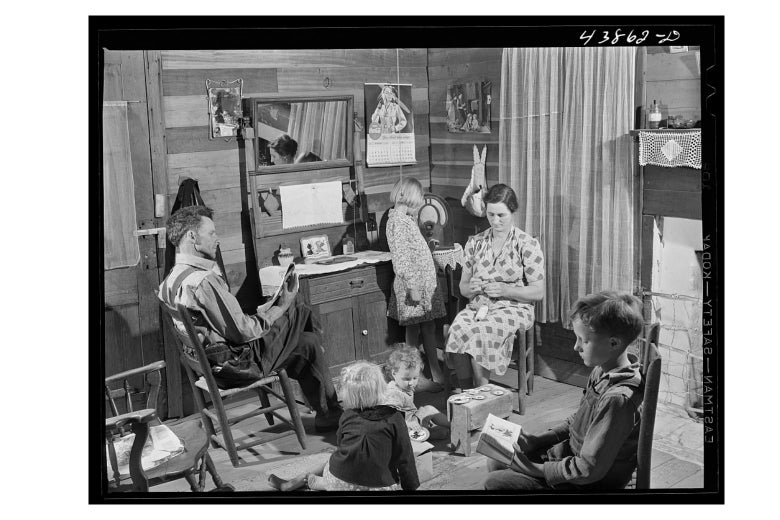
At that place is some evidence, produced by scientists studying parent-child interactions, that parental playfulness, specially with infants and young toddlers, is benign to children's cognition and social relationships. In the midcentury period, researchers plant that mothers who were playful with their babies (mimicked their sounds, made funny faces) held their attention longer, and their babies became better at exploring the globe. In experimental contexts, mothers who simulated a depressed condition when interacting with their infants—dampened their affect and decreased their responsiveness; in other words, weren't playful at all—increased their babies' negative touch on and decreased their responsiveness.
Psychologists Dorothy G. Singer and Jerome Singer, in their 1990 book well-nigh play and imagination, described research that institute that older children who had parents who told them stories and played fantasy games with them were more imaginative, themselves. "Through play with parents, children learn social advice skills, the value of their own 'melancholia displays,' how to employ those signals with their peers, and how to decode the social and affective signals of their peers," the Singers wrote. Cautioning parents to exist conscientious to "retain a sense of nobility," the Singers added that "nosotros must remember when to withdraw from the game and permit children their own infinite to play."
Brian Sutton-Smith was a lifelong scholar of play. In a 1974 book, How to Play With Your Children (And When Not To ), Sutton-Smith and his married woman and co-author, Shirley Sutton-Smith, offered age-past-age strategies for facilitating parent-child play, from peek-a-boo with infants to creative writing exercises with 7-year-olds. Yet in 1993, when Sutton-Smith penned an introduction to a book on the topic of parent-child play, he wrote that he looked back at the couple'due south earlier book and thought it was very "optimistic." "I want to raise the question of whether, despite an plainly modern business organization with play and child growth, our efforts aren't besides instigated by our desire to control and socialize children," he wrote.
Assessing whether he would, afterward a few decades of research, change the message of How to Play With Your Children, he pushed back against those advising playfulness for the sake of "making your kids smarter": "We favor occasional parent play mainly for the way it increases the competence and vividness of family or peer play relationships rather than for any fairly marginal academic outcomes." And a parent playing with their kids could go it wrong: "The occasional participation with and modeling of play for children seems to have a powerful influence on their ain playfulness, unless information technology is too intrusive, overpowering, or i-sided."
From the betoken of view of some people who spend a lot of fourth dimension with immature children, the hallmarks of the child whose parents over-involved themselves in pretend play are obvious. My sister, Sarah Onion Alford, founder and head of a play-based outdoor preschool serving infants through v-year-olds in Maine, said that she feels children in her school now lack a facility in group play that used to be more common. She describes superior play, usually attained by the 4- and 5-year-olds at her school, as "the ability to take a lot of fluidity in narrative"—to switch every bit a group from "pirates" to "astronauts" in a super-quick and unified manner, which shows "their ability to mind to one some other and contribute new ideas" and "allows their brains to make connections between unrelated things."
Alford told me she thought parents who played "pretend" with their children too much undermined the evolution of this fluidity because "adults don't call up that mode anymore." Indeed, the open-endedness and indeterminacy of children's play was i of the things the mothers I asked cited as "abrasive" when contemplating playing with their children: "Equally a kid I used to similar playing pretend but at present I'd rather clean the toilet," 1 wrote. "Requite me a board game or something with construction and I'm good. Something meandering with no clear boundaries makes me 😔."
In her own parenting, my sis doesn't play pretend. Her way of being with my nieces when they were pocket-sized—kind, attentive, and firm; a provider of succor, snacks, and schedule, merely not a playmate—was a model that made me feel like possibly I could be a mom. I asked her, "But kids dear it when nosotros play with them! Don't you feel mean, proverb no?" She said, wisely: "They love candy, likewise. And you can't just permit them eat a lot of candy all the time."
So, how to change your relationship with your child'due south pretend play? First of all, don't exercise information technology if you feel annoyed, bitter, or "off" most it. The Sutton-Smiths began their volume with the caveat: "You do not have to keep playing night and day. In fact, the ruling principle in this book is, 'If information technology isn't fun, forget it.' " Say no to play, they wrote, "if you feel like yous are intruding, or you feel it is a duty, or you are besides grumpy, preoccupied, or just plain wearied to enjoy the fun you are supposed to be having together." Every contemporary source I consulted, from the people who wanted parents' hands off children'south play to the adult-child play cheerleaders, emphasized the idea that you should not play if yous resent it. "Kids pick up on inauthenticity," Lillard said. "And what a distressing bulletin that is, if a child picks up on, 'They don't really desire to play with me.' "
But as anyone who'south ever been begged to "come, come!" by a toddler knows, not-playing with your kids takes work. You have to figure out how to exist with them in your house, in a way that's accurate to yourself and nurturing to them, if you're non going to practise whatever they want every fourth dimension they inquire. To answer the question of how to be playful-simply-not-intrusive, authentic-simply-nowadays (which is really a query most how to structure your everyday domestic interactions), we venture away from science and into the realm of parenting advice. Here's what'southward worked for me, so far.
The RIE way of parenting—a fascinating prepare of ideas stuck with a truly terrible name, "Resource for Infant Educarers"—was inspired past midcentury Hungarian pediatrician Emmi Pikler and popularized in the United states past Magda Gerber. Janet Lansbury's pop blog, Elevating Child Care—y'all may have seen links to it in your own parenting Facebook grouping—is probably the best-known exponent of these ideas today. 1 of the core tenets of RIE is the encouragement of independent play, which believers advocate should begin when the baby is very pocket-sized. Lie the infant on a blanket, Lansbury counsels, and practice letting her look at the world around her or manipulate simple open up-concluded toys. Given a completely secure rubber infinite, the baby can be alone for cursory periods while y'all shower or get java. Parents are brash to practice leaving for increasingly long stretches of fourth dimension, and so that the infant gets used to the feeling of self-entertaining. (If y'all're an attachment parent following the baby-wearing, constant-proximity manner, this may all seem very common cold, but a baby accustomed to lying on a coating solitary gazing at sunbeams for a few minutes becomes a toddler who tin can build independently with Duplo—or so the theory goes!)
Parents of any age child tin can prefer another unremarkably recommended practice: Cascade pure attention into them for a period of time, dropping all other activities and doing whatsoever they want. This sounds onerous at first glance, but is actually really freeing in practice—y'all put your phone away (everyone agrees this is a must), stop thinking about dinner prep, and just float on the tides of childish whim for a while by seeing what the child is doing. This observation idea makes intuitive sense to me: I can be a Zen main sitting on the couch, watching my child rearrange her tiny bird figurines at her table and occasionally agreeing that yeah, indeed, they are "birdies," and 1 of them is blue. I don't accept to start pretend-flying them through the air and make cheeping noises. I've never been not bad at meditating, only this feels good.
The pull a fast one on to enjoying this child-driven quality time is to endeavor to fade into the groundwork a little bit, energetically speaking. Lawrence Cohen, a psychologist whose book Playful Parenting advocates for increased parental attention to play, believes that parents who over-entertain become "exhausted" and "burn down out quickly." If you meet the child on his level and mostly lookout man what they're doing instead, it's still an human action of love and attention without existence such a draining experience. When you've been enlisted in their play, attempt to intervene as minimally as possible. Suggest fixes instead of fixing problems yourself; don't redirect what they're doing, and follow their pb instead.
You lot can demonstrate, through this practise of observation as well as stage-setting and scheduling, that you call up your children'south play is interesting, valuable, and good—even if you lot're not always participating yourself. The Singers' research showed that parents' attitudes toward children'due south creativity—openness, acceptance, encouragement, and the maintenance of time, space, and props to carry out play—could predict children'south afterwards levels of imagination. Schedule fourth dimension for child-driven solo play at home, and try to seize on and expand those moments when your child is happily playing alone. If I come across that my toddler is having some nice solo dolly time, I put off non-vital trips exterior of the house until she's done with what she's doing, or at least expect until she seems to be at a good stopping betoken to interrupt her.
Some other arroyo revolves around the theory that toddlers and preschoolers can exist brought into your household chores, which provide a different way to exist together that tin can be meaningful to both parties. Angeline Lillard, with her co-authors Jessica Taggart and Megan J. Heise, tested 100 children between ages 3 and 6 to see if they would prefer "real" activities to "pretend" ones. They asked children most activities like talking on a phone, riding a tractor, fishing, feeding a baby, and cutting vegetables. For most of this list of activities, children chose "real" over "pretend"—showing, in these researchers' view, that Maria Montessori'southward belief that children would thrive more than if provided real-life activities, every bit opposed to fantasy play, might take been correct.
Simply how to bring them in? There's an fine art to information technology. In Religion Collins' Waldorf-inspired advice book, Joyful Toddlers and Preschoolers, at that place'due south a whole section offering very item advice on how to practice household chores with the nether-5 fix. If you can pull off vacuuming or folding laundry with a kid, you can connect with them, increase their sense of competence, and reclaim the parts of the mean solar day when your child isn't awake for your own leisure.
Finally, there are probably all kinds of ways yous already spend time with your kids that aren't pretend play and aren't onerous to you—perhaps they're even pleasurable. Start allowing those to "count" in your mind. "It'due south actually important to snuggle upwardly with your kids and read with them, take a snow day and play board games all morning, or get for walks where you're really talking and really present with each other," my sister said. None of these things seem like "play," in the "down on the rug" sense, but they're all driven by togetherness—and information technology's that feeling of happy ease that matters near.
bardwellcreat1988.blogspot.com
Source: https://slate.com/human-interest/2019/03/parent-child-pretend-play-expectations.html
0 Response to "Loving a Baby Mommy Playing With a Baby"
Post a Comment