Need Money to Drive Back Home to Family
The adult 'boomerang kids' moving abode to their parents
(Image credit:
Getty Images
)
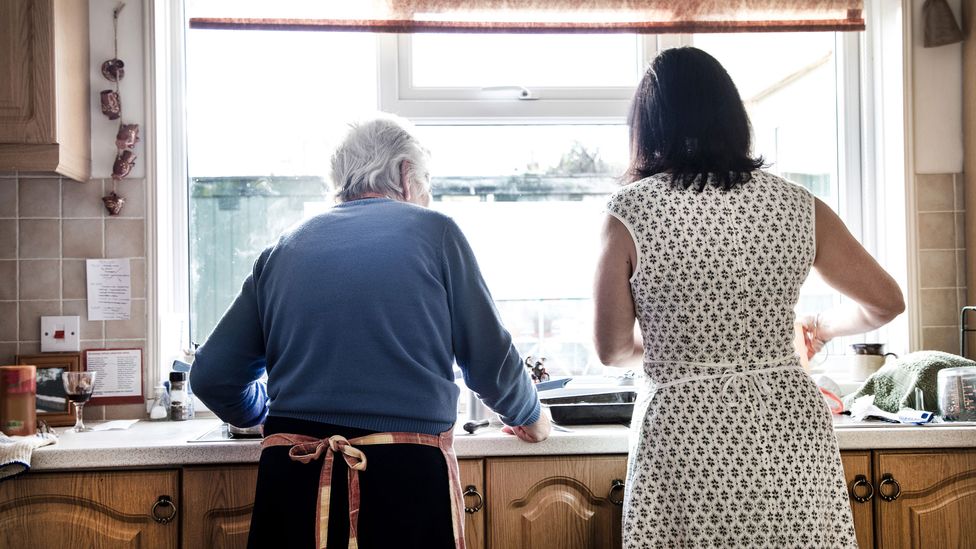
With costs of living increasing, a 'boomerang' period of moving back in with parents could exist the norm, not the exception, for people in their 20s and 30s.
I
In early March 2020, Sheridan Block, 30, had simply finished a year abroad in Marseilles, France, as a volunteer English teacher to refugees. She flew domicile to Jacksonville, Florida, to spend fourth dimension with her maternal grandparents – her grandfather was recovering from health issues at the time. Her plan was to stay a few months to help intendance for them while likewise saving money, paying off some student debt and credit carte bills before returning abroad.
Then, the pandemic hit. "It was kind of a spiral," says Block.
In commutation for living hire-free, she helped drive her grandparents to appointments, ran errands, cooked and did chores around the firm. She concluded up staying nearly ii years. "I was able to salvage enough money to pay off all those debts that I had, to finance a motorcar and then ultimately to movement out," she explains. It was benign financially, she says, and expert to be close to family, but it required her to adjust her ideas of what machismo should wait similar.
Cake is among a growing group of 'boomerang kids' – adult children who return to their parents or grandparents' homes after moving out. This group of adults is on the ascent – and non just because of the pandemic. In July 2020, 52% of young adults in the United states of america resided with one or both of their parents, according to a Pew Research Center assay – the highest percentage the United States has seen since the finish of the Great Depression, in 1940. In the UK, the proportion of single, child-free 20-to-34-yr-olds living with their parents went up 55% between 2008 to 2017, according to enquiry from Loughborough University.
In Western cultures particularly, moving abroad from habitation has traditionally been considered a crucial step in becoming an contained developed. Merely as the number of boomerang kids continues to rise in countries such as the U.s.a., U.k. and Canada, this may be set to change – and with information technology, our notion of what the stages of adult independence look similar.
An upwardly blast
When she moved in with her grandparents, Block noticed she was far from alone among her peers.
"I found that a lot of friends, and even some dates I went on, were kind of in the same boat," she says. "I had met ane guy [on a appointment] who moved from San Francisco back in with his mom in Jacksonville. That's just a reality now, to do whatever yous've got to do to save money."
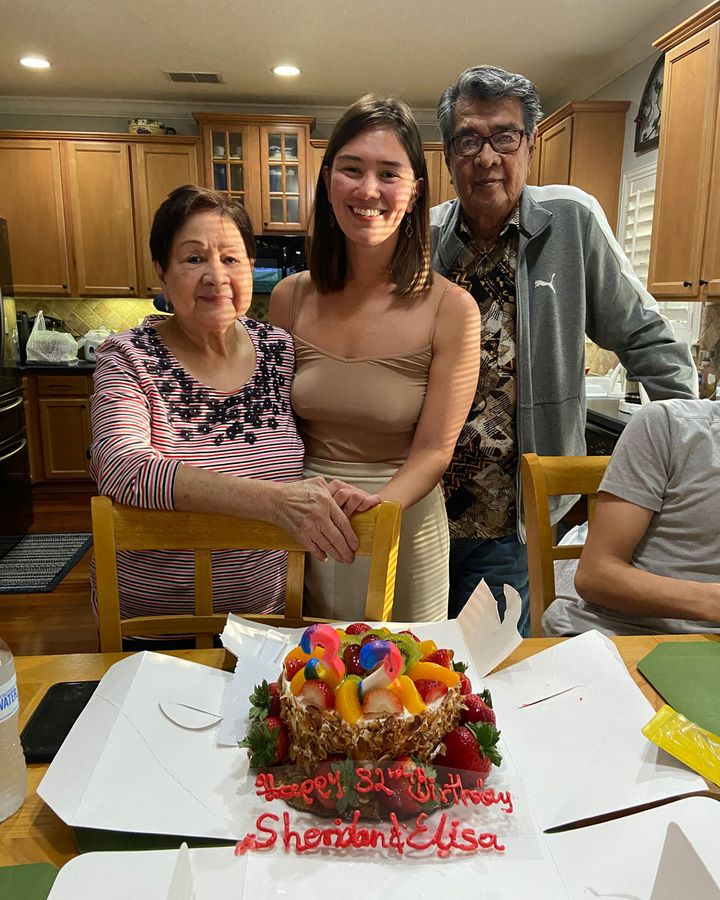
After returning from teaching abroad in France, Sheridan Block, 30, moved dorsum dwelling with her family during the pandemic (Credit: Courtesy of Sheridan Cake)
Family Tree
This story is part of BBC's Family unit Tree serial, which examines the issues and opportunities parents, children and families face today – and how they'll shape the world tomorrow. Coverage continues on BBC Time to come.
There are many reasons for immature people to motion back home, says Joanne Hipplewith, family unit therapist at the Institute for Family Therapy in London. The primary reason is the high cost of living in major cities, though university tuition is another factor in the United states and UK.
"There is a trend to staying at home longer, because everything is so expensive," says Hipplewith. Staying dwelling house, for many, means financial support from family every bit they prepare for avant-garde degrees or starting a career. And it's condign increasingly normal: "[Young people are] prepared to become back home," says Hipplewith.
Though the 'boomerang' stage has been on the rising for at to the lowest degree the last decade, the pandemic has added a few new contributing factors: many who planned to go away for college could not – university campuses closed across the earth – and others who might accept otherwise moved for a task after college delayed leaving abode considering in-function work has not been bachelor.
For many, the boomerang phase is temporary. But it still may final many months – or even years, similar it did for Block – to enable boomerangers to pay off student debt, relieve for a down payment or plant themselves in a career without meantime worrying about high rents, tuition and student debt.
"It's temporal – a 1-year, ii-year or v-year plan," says Jenna S Abetz, associate professor of communication at the College of Charleston, United states. "This is just a transition chapter."
Redefining the milestones of adulthood
For many, a return home after living abroad – or direct after university – tin can experience like a regression and loss of recently won independence.
"You lot learn to go an adult [in academy]," says Hipplewith. "Yous take friends. You're doing what you want to do. So, information technology can be really quite devastating because you're coming dorsum under someone else's rules."
Boomeranging forces adults in their 20s and 30s to face assumptions about independence, and this can come with feet. Across feeling they 'regressed' by moving habitation, many adult children returning abode experience a trickle-downwardly event to other life milestones. Abetz says that twenty- and 30-somethings living with their parents are getting married later and also delaying having children, which tin can exit them feeling fifty-fifty more "behind".
"I expected something very unlike from adulthood," agrees Cake. By her 30s, she says, she had one time thought she'd have a successful career, own a home, be married and have a family unit, forth with a solid savings and retirement plan. "Unfortunately, that didn't happen," she says. At times, living with her grandparents made her feel "like a failure not having those adulthood dreams checked off".
Still, in that location are benefits to boomeranging, say experts. Many of these adults are finding an increased ability to exercise work they detect meaningful, rather than have a job that just pays the bills, says Abetz. During Covid-19, this has likewise meant some boomerangers have been able to choose jobs with lower take a chance factors, though this is largely dependent on their socioeconomic situation.
Socially, boomerang kids also have an opportunity to strengthen relationships with their parents at a time when they typically would have been establishing ties with new friends. It's an unexpected "opportunity for mutual support and closeness with families," says Abetz, that could lead to boomerang kids developing potent family back up networks in the long-term. "Parents sometimes similar to accept kids back domicile for a little while," says Abetz. "They view that every bit a special fourth dimension they wouldn't necessarily have gotten."
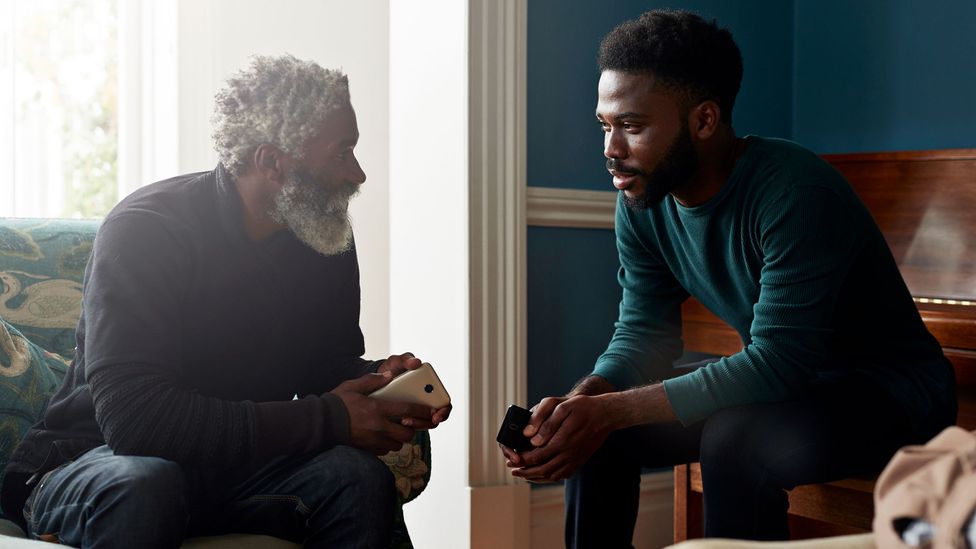
For some boomerang kids, moving back in with their parents means delaying life milestones – but it tin can also bring them closer to their families (Credit: Getty Images)
Another new normal
Abetz and Hipplewith both believe this is not just a pandemic-induced trend, and foresee an increasing number of adults bunking with parents as costs of living continue to rise. In the future, after moving away for university or college, says Abetz, life paths may be a little "less linear. Information technology might exist back and forth. It might be, subsequently college, you lot'll be home for six months or a couple of years".
Hipplewith hopes that as boomerang stages become more than common in Western cultures, young adults volition feel less force per unit area to conform to societal expectations of going to university, moving out and finding a job. Hipplewith encourages immature people to view a return to abode, or remaining home, as "informed decision-making". She says, "Let's move abroad or de-link becoming an adult with the act of moving away."
And some research indicates perceptions have already begun to change. Block agrees boomerang moves are a new reality for her generation, and i that can potentially re-frame an unhelpful mindset.
"When I was traveling, my friends from other countries, especially those where family is super close, similar in Asia, would say how funny it was that Americans are then obsessed with moving out at 18. Even my grandma, who is from the Philippines, would make comments almost it," she says.
"I recollect my generation is learning to be OK with the idea that non everyone's path is meant to wait the same, and success is all nigh perception," continues Block. "Adulthood is actually only being old plenty to take responsibilities and pay bills; that doesn't go away if you movement in with parents once more."
bardwellcreat1988.blogspot.com
Source: https://www.bbc.com/worklife/article/20220208-the-adult-boomerang-kids-moving-home-to-their-parents
0 Response to "Need Money to Drive Back Home to Family"
Post a Comment