Great Pearl How It Was Lost and Found Again
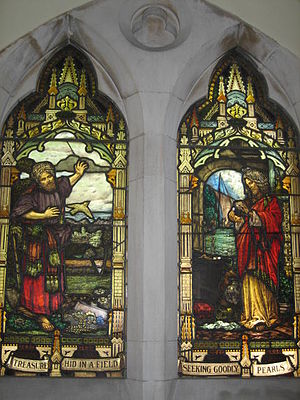
The Parable of the Pearl (also called the Pearl of Nifty Price) is one of the parables of Jesus. Information technology appears in Matthew thirteen[1] and illustrates the great value of the Kingdom of Sky.
This is the penultimate parable in Matthew thirteen, coming just earlier the Parable of the Dragnet. Information technology immediately follows the Parable of the Hidden Treasure, which has a similar theme. Information technology does not announced in the other synoptic gospels,[ii] but a version of this parable does announced in the not-canonical Gospel of Thomas, Saying 76.[three] The parable has been depicted by artists such every bit Domenico Fetti.
The parable reads equally follows:
Once again, the kingdom of sky is like unto a merchant man, seeking goodly pearls: Who, when he had institute ane pearl of swell toll, went and sold all that he had, and bought it.
Interpretation [edit]

This parable is generally interpreted every bit illustrating the great value of the Kingdom of Heaven. Theologian Due east. H. Plumptre, in Anglican bishop Charles Ellicott'due south Commentary, notes that:
"the caprices of luxury in the Roman empire had given a prominence to pearls, as an commodity of commerce, which they had never had earlier, and have probably never had since. They, rather than emeralds and sapphires, were the typical instance of all costliest adornments.[4] The story of Cleopatra and the fact that the opening of a new pearl marketplace was one of the alleged motives which led the Emperor Claudius to invade Uk, are indications of the value that was then set on the "goodly pearls" of the parable."[v]
Theologian John Nolland also notes that pearls at that fourth dimension had a greater value than they practice today,[6] and it thus has a similar theme to its partner, the parable of the subconscious treasure. Nolland comments that information technology shares with that parable the notions of "adept fortune and demanding action in attaining the kingdom of sky",[6] but adds in this case the notion of "diligent seeking".[6]
The valuable pearl is the "deal of a lifetime" [six] for the merchant in the story. However, those who do non believe in the kingdom of heaven plenty to pale their whole future on information technology are unworthy of the kingdom.[seven]
This interpretation of the parable is the inspiration for a number of hymns, including the anonymous Swedish hymn Den Kostliga Pärlan (O That Pearl of Great Toll!), which begins:
O that Pearl of great toll! have you found it?
Is the Savior supreme in your love?
O consider information technology well, ere you reply,
As you hope for a welcome above.
Accept you lot given upward all for this Treasure?
Accept you lot counted past gains equally but loss?
Has your trust in yourself and your merits
Come up to naught before Christ and His cross?[viii]
A less common interpretation of the parable is that the merchant represents Jesus, and the pearl represents the Christian Church.[nine] This interpretation would requite the parable a similar theme to that of the Parable of the Lost Sheep, the Lost Coin, and the Prodigal Son.
Pope Pius XII used the phrase to describe virginity.[10]
"Pearl of Swell Price" is the championship of a selection of Mormon writings, ane of the standard works of The Church building of Jesus Christ of Latter-twenty-four hour period Saints and some other Latter Day Saint denominations.

[edit]
Chrysostom: "The Gospel preaching not simply offers manifold gain every bit a treasure, but is precious as a pearl; wherefore afterwards the parable concerning the treasure, He gives that concerning the pearl. And in preaching, two things are required, namely, to be discrete from the business organization of this life, and to be watchful, which are denoted by this merchantman. Truth moreover is ane, and not manifold, and for this reason information technology is one pearl that is said to be found. And as one who is possessed of a pearl, himself indeed knows of his wealth, just is non known to others, often concealing it in his hand considering of its modest bulk, so information technology is in the preaching of the Gospel; they who possess it know that they are rich, the unbelievers, not knowing of this treasure, know not of our wealth.
Jerome: By the goodly pearls may exist understood the Law and the Prophets. Hear then Marcion and Manichæus; the good pearls are the Police force and the Prophets. One pearl, the most precious of all, is the knowledge of the Saviour and the sacrament of His passion and resurrection, which when the merchantman has plant, like Paul the Apostle, he straightway despises all the mysteries of the Law and the Prophets and the old observances in which he had lived blameless, counting them equally dung that he may win Christ. (Phil. 3:eight.) Non that the finding of a new pearl is the condemnation of the old pearls, but that in comparison of that, all other pearls are worthless."
Gregory the Keen: " Or by the pearl of price is to be understood the sweetness of the heavenly kingdom, which, he that hath found it, selleth all and buyeth. For he that, as far every bit is permitted, has had perfect knowledge of the sweetness of the heavenly life, readily leaves all things that he has loved on world; all that once pleased him among earthly possessions now appears to have lost its beauty, for the splendour of that precious pearl is alone seen in his mind."
Augustine: " Or, A man seeking goodly pearls has establish one pearl of bully price; that is, he who is seeking good men with whom he may live profitably, finds one solitary, Christ Jesus, without sin; or, seeking precepts of life, by aid of which he may dwell righteously among men, finds beloved of his neighbour, in which one rule, the Apostle says, (Rom. xiii:ix.) are comprehended all things; or, seeking proficient thoughts, he finds that Give-and-take in which all things are contained, In the beginning was the Give-and-take. (John 1:1.) which is lustrous with the light of truth, stedfast with the force of eternity, and throughout like to itself with the dazzler of divinity, and when we have penetrated the shell of the flesh, will be confessed as God. But whichever of these iii it may be, or if there be anything else that can occur to united states, that can be signified under the figure of the i precious pearl, its preciousness is the possession of ourselves, who are not free to possess it unless we despise all things that can exist possessed in this earth. For having sold our possessions, we receive no other return greater than ourselves, (for while nosotros were involved in such things nosotros were not our own,) that we may over again requite ourselves for that pearl, not because nosotros are of equal value to that, but because we cannot give anything more than."
Gospel of Thomas [edit]
A version of the parable also appears in the Gnostic Gospel of Thomas (Saying 76):[3]
Jesus said, "The Father's kingdom is like a merchant who had a supply of merchandise and found a pearl. That merchant was prudent; he sold the merchandise and bought the single pearl for himself. And so also with you, seek his treasure that is unfailing, that is enduring, where no moth comes to eat and no worm destroys."
—Gospel of Thomas 76, Patterson/Meyer translation
This work's version of the parable of the Hidden Treasure appears later (Saying 109), rather than immediately preceding, as in Matthew.[12] However, the mention of a treasure in Saying 76 may reflect a source for the Gospel of Thomas in which the parables were adjacent,[12] so that the original pair of parables has been "broken apart, placed in dissever contexts, and expanded in a way characteristic of sociology."[12] In Gnostic thought the pearl may correspond Christ or the true self.[12] In the Gnostic Acts of Peter and the Twelve, constitute with the Gospel of Thomas in the Nag Hammadi library, the travelling pearl merchant Lithargoel is eventually revealed to be Jesus.[xiii]
Depictions [edit]
At that place have been several depictions of the New Testament parable in art, including works past Domenico Fetti, John Everett Millais and January Luyken.
In popular civilization [edit]
In literature [edit]
The parable is referenced in Nathaniel Hawthorne's novel The Scarlet Letter on page 82:
"But she named the babe 'Pearl', every bit beingness of great toll- purchased with all she had,- her mothers just treasure!"[fourteen]
In other media [edit]
The parable is referenced in Star Trek by Scotty at the end of an episode in the original serial entitled "The Empath".[xv]
See also [edit]
- Five Discourses of Matthew
- Life of Jesus in the New Testament
- Ministry of Jesus
- The Pearl of Keen Price - ane of the standard works in The Church of Jesus Christ of Latter-day Saints.
References [edit]
- ^ Matthew xiii:45–46
- ^ Cambridge Bible for Schools and Colleges on Matthew xiii, accessed 15 January 2017
- ^ a b Gospel of Thomas: Lamb translation and Patterson/Meyer translation.
- ^ Matthew 7:half-dozen; 1 Timothy 2:9
- ^ Plumptre, Eastward. H., Ellicott's Commentary for Modern Readers on Matthew xiii, accessed 15 January 2017
- ^ a b c d John Nolland, The Gospel of Matthew: A commentary on the Greek text, Eerdmans, 2005, ISBN 0-8028-2389-0, pp. 565–566.
- ^ Craig S. Keener, A Commentary on the Gospel of Matthew, Eerdmans, 1999, ISBN 0-8028-3821-ix, p. 392.
- ^ The Cyber Hymnal, O That Pearl of Bang-up Price!
- ^ Herbert Lockyer, All the Parables of the Bible, Zondervan, 1988, ISBN 0-310-28111-3, p. 200.
- ^ Pope Pius XII, Sacra Virginitas
- ^ a b c d Brad H. Young, The Parables: Jewish Tradition and Christian Interpretation, Hendrickson Publishers, 2008, ISBN ane-59856-303-three, pp. 202–206.
- ^ David Noel Freedman, Allen C. Myers, and Astrid B. Beck, Eerdmans Dictionary of the Bible, Eerdmans, 2000, ISBN 0-8028-2400-five, p. 1041.
- ^ Hawthorne, Nathaniel (1878). The scarlet alphabetic character. The Library of Congress. Boston, J.R. Osgood and company.
- ^ "The Star Trek Transcripts - The Empath". www.chakoteya.cyberspace . Retrieved 2019-11-23 .
External links [edit]
-
 Media related to Parable of the Pearl at Wikimedia Commons
bardwellcreat1988.blogspot.com
Source: https://en.wikipedia.org/wiki/Parable_of_the_Pearl
0 Response to "Great Pearl How It Was Lost and Found Again"
Post a Comment